
Expedition 🇦🇺 Australia
Echidna in Australia
The spiny enigma — an egg-laying mammal with a beak, a pouch, and a tongue that flickers faster than a snake's.
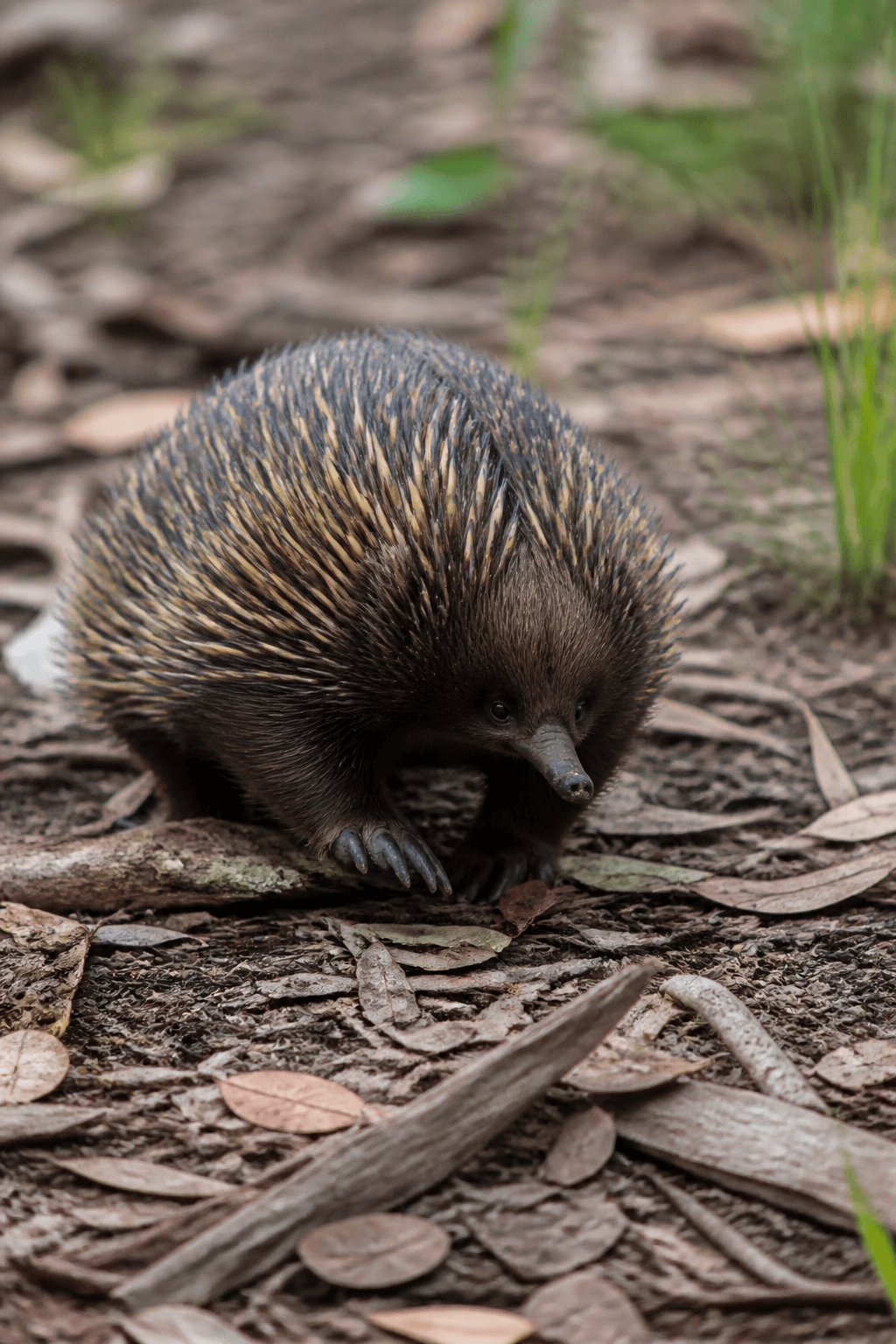
The species
The short-beaked echidna is one of only five monotreme mammals on Earth — it lays leathery eggs like a reptile, then nurses its puggle in a pouch. Covered in spines with a long snout and sticky tongue, it trundles through Australian bush probing for ants and termites.
Habitat in Australia
Forest, scrub, grassland, and desert across Australia and Tasmania suit short-beaked echidnas. They are active by day in cooler weather and at night in hot regions, foraging for ants, termites, and beetle larvae.
Where to spot one
Great Ocean Road
Victoria
Coastal eucalyptus forest and Kennett River's wild koalas — one of the most reliable places to spot them in the wild.
Kangaroo Island
South Australia
Kangaroos, koalas, and sea lions on an island sanctuary off Adelaide — compact Australian wildlife in one place.
Uluru-Kata Tjuta National Park
Northern Territory
Red centre country where red kangaroos graze at dawn against the backdrop of Uluru.
Daintree Rainforest
Queensland
Ancient tropical forest at the edge of the Great Barrier Reef — cassowaries, tree kangaroos, and forest birds.
Conservation status
Short-beaked echidnas are Least Concern and widespread across Australia. They are occasionally killed on roads but populations remain stable.
Keep exploring
Keep exploring
- Echidnacommon • Forest & Scrub
- Australia12 species
- Koala in AustraliaWhere to find it
- Kangaroo in AustraliaWhere to find it
- Great White Shark in AustraliaWhere to find it
- Platypus in AustraliaWhere to find it
- Kookaburra in AustraliaWhere to find it
- Tasmanian Devil in AustraliaWhere to find it
- Emu in AustraliaWhere to find it
- Saltwater Crocodile in AustraliaWhere to find it
- Wombat in AustraliaWhere to find it
- Dingo in AustraliaWhere to find it
- Quokka in AustraliaWhere to find it
Free on iOS
Log the Echidna in Australia
Spot one in the wild — scan it in Catch'Um to log your common discovery.